Finding your information
How to read your electricity bill
4 min read
Your electricity bill can be difficult to understand because it has so much information about you and your power usage. Here you’ll find everything you need to know about the various charges on your bill and how they’re calculated.
What’s on the bill?
Your electricity bill includes information about you, your home, your electricity usage, and other charges that apply. Each bill also tells you your current balance and the amount due.
The main sections are:
- Account details
- Customer details
- Details of your previous bill
- Breakdown of electricity usage
- Standing Charges
- PSO levy
- VAT
- Total amount due
- If your contract has ended
Account details
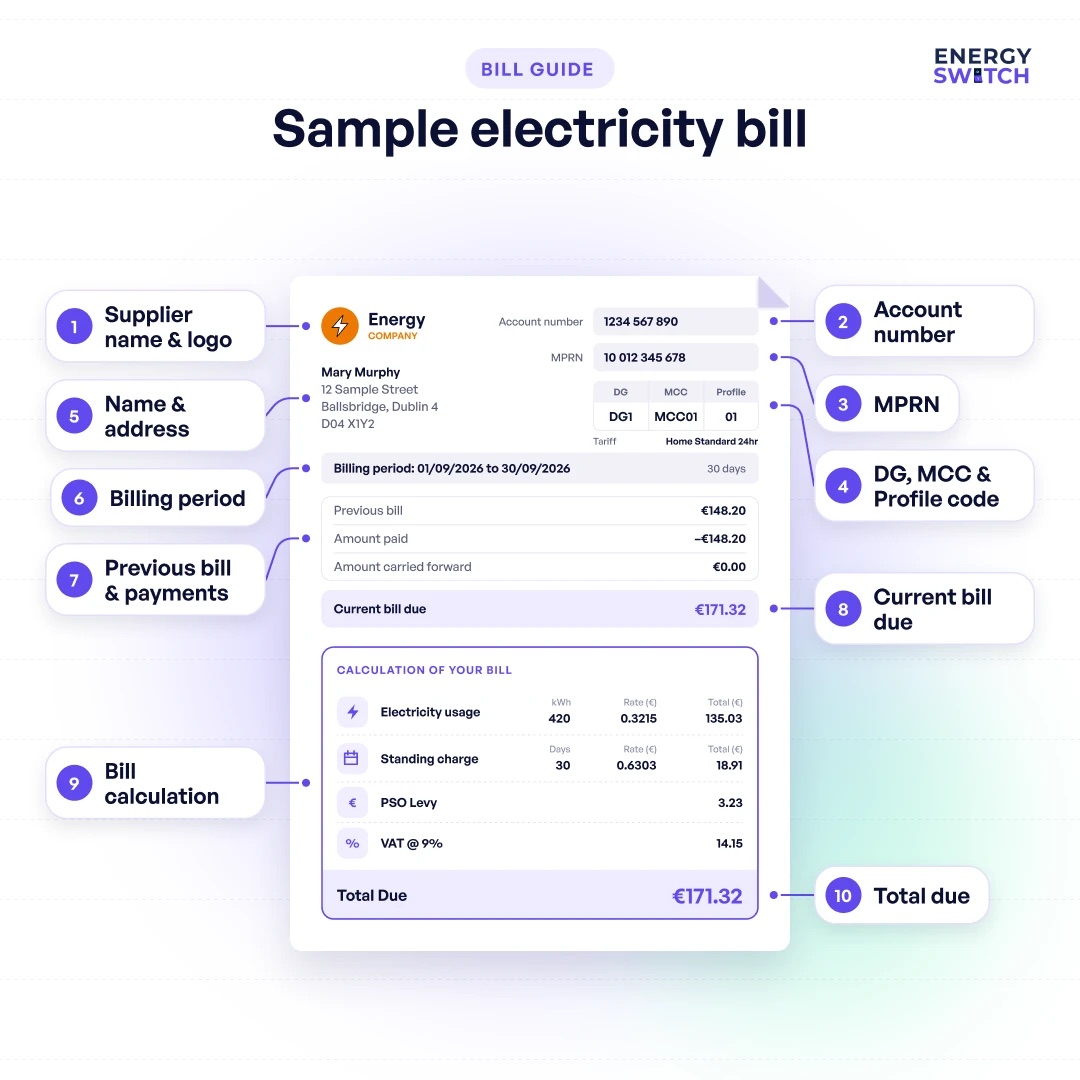
Your account details can usually be found at the top right-hand corner of your electricity bill, including:
- Account number: The number identifying your account with your electricity supplier
- Tariff name: The name of your electricity plan
- MPRN: Your Meter Point Reference Number, which identifies your property’s connection to the electricity grid
- Meter Configuration Code (MCC): Identifies the type of electricity meter you have
- Distribution Group (DG Code): Usually DG1 or DG2; this identifies whether you’re an urban or rural customer
- Profile Code: Indicates your expected consumption level so you’re charged the right tariffs
Customer details
This section shows the name and address of the customer. On some bills the supply address and the billing address may be provided separately, so don’t worry if your address appears twice.
Details of your last bill
This is a summary of your previous bill, details of the payments made on that bill, and the balance brought forward. If you haven’t paid all of the previous bill, the remaining balance will be added to your current bill.
Breakdown of electricity usage
The main portion of your bill is a breakdown of your electricity usage in the billing period. This includes the number of kWh units used, the rate per kWh, and the amount due.
If your electricity plan has multiple rates, such as a smart plan with day, night, and peak rates, each is shown separately. For each different rate you will be shown the usage in that time period, the price per kWh, and the total – which is the price multiplied by usage.
Standing charges
Below your electricity usage you will see your standing charge for the billing period. This shows the number of days in the billing period, the daily rate, and the total.
PSO levy
The Public Service Obligation (PSO) levy is shown as a monthly rate, rather than a daily one, so the bill shows one or two “units” depending on your billing cycle. After this comes the monthly rate, and the total amount for this period.
The PSO Levy for 2026/2027 is €6.12 annually, or €0.51 every month, before VAT.
VAT on your electricity bill
All charges on your electricity bill are subject to VAT at 9% until the end of 2030. This is displayed after the breakdown of charges so all figures above are exclusive of VAT.
The VAT section may show your electricity charges before tax, as well as the amount of tax due.
If your contract has ended
If your contract has ended during the billing period, you’ll see details for both electricity usage and standing charges.
First, you will see the usage, rates, and amount due for each tariff up to the end of the contract.
After this you’ll find the out of contract usage, rates, and the amount due from that date up to the end of the billing period. The same applies to standing charges.
The total amount due
The main figure on the bill is the total that you owe for the billing period. This includes all charges, VAT, and any balance carried over from the previous billing period.
Why understanding your bill matters
Being able to read your electricity bill lets you see how much you’re using over the course of the year, what you’re paying, and how much you can save by switching.
It is also the best place to look for information about your property and electricity connection, such as your MPRN, meter type, or contract end date.
FAQs
How do I receive my electricity bill?
Depending on whether you have paperless billing, you will receive your electricity bill by post or email. It can also be viewed on your online account with your supplier.
When do I pay my electricity bill?
The due date for your bill will be displayed at the bottom below the breakdown of charges and total due.
What’s the difference between an estimated and actual bill?
An estimated bill is based on estimates of your electricity usage, while an actual bill is based on real meter readings. Estimated bills are more common in homes without smart meters.
Was this guide helpful?
Your feedback helps us improve our guides.


