
Billing & Charges
How to read your gas bill
2 min read
Your gas bill contains important details such as your current plan, how much you owe, your GPRN, your annual consumption band, and emergency contact information. The main sections on your bill are explained here.
What’s on the bill?
- Your name and address
- Your supplier
- Account number
- GPRN and AC Band
- Plan name
- Amount due
- VAT
- Standing charge
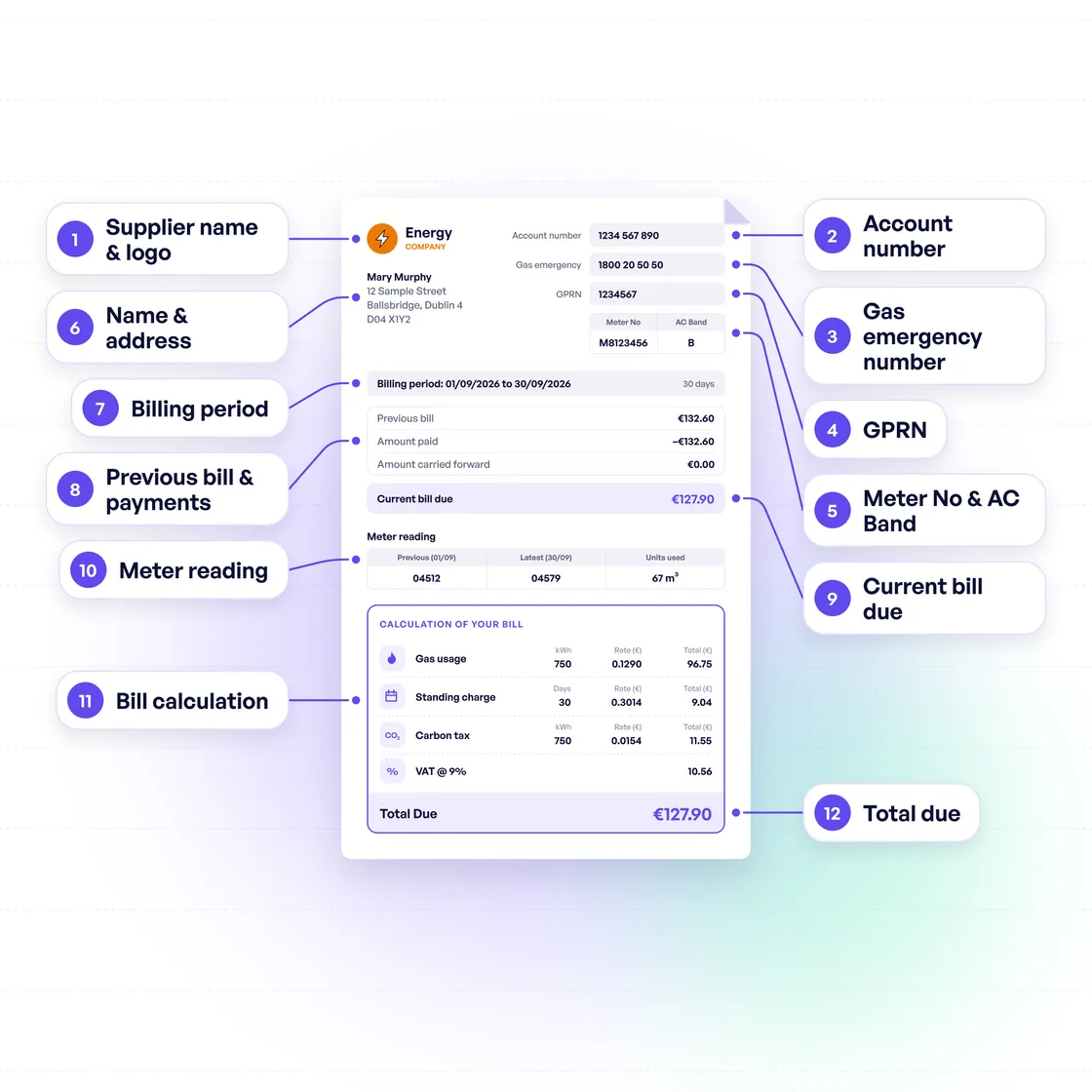
Account details
Your name, address, the date, and your gas account number will be displayed clearly on your bill. You should have your gas account number ready if you need to contact your gas supplier for any reason, so they can quickly find your account and address your issue.
Plan name
The name of your current gas plan will also be displayed somewhere on your bill. The location varies by supplier, but it may be found at the top of your bill, in a separate section labelled ‘tariff category’, or under a description of your charges.
Knowing your current plan will help you switch to a cheaper plan when your 12-month discount ends.
GPRN
Your GPRN is a 7-digit number on your gas bill. Every property has a unique GPRN, allowing Gas Networks Ireland and suppliers to identify your home. This can usually be found in the top right corner of your bill.
AC band
Your AC Band can also be found here. This is your Annual Consumption Band, which is your estimated or expected gas usage over 12 months.
If you are a residential customer, your AC Band will be either A, B or C – with A being the lowest estimated usage and C being the highest.
Current bill and balance
You’ll also find the amount you owe for the most recent billing period and your outstanding balance. VAT will also be displayed, and you can usually see a breakdown of charges such as your standing charge and carbon tax.
The bill will also tell you the due date, or the date that the direct debit was completed, as well as your chosen payment method.
Was this guide helpful?
Your feedback helps us improve our guides.


